
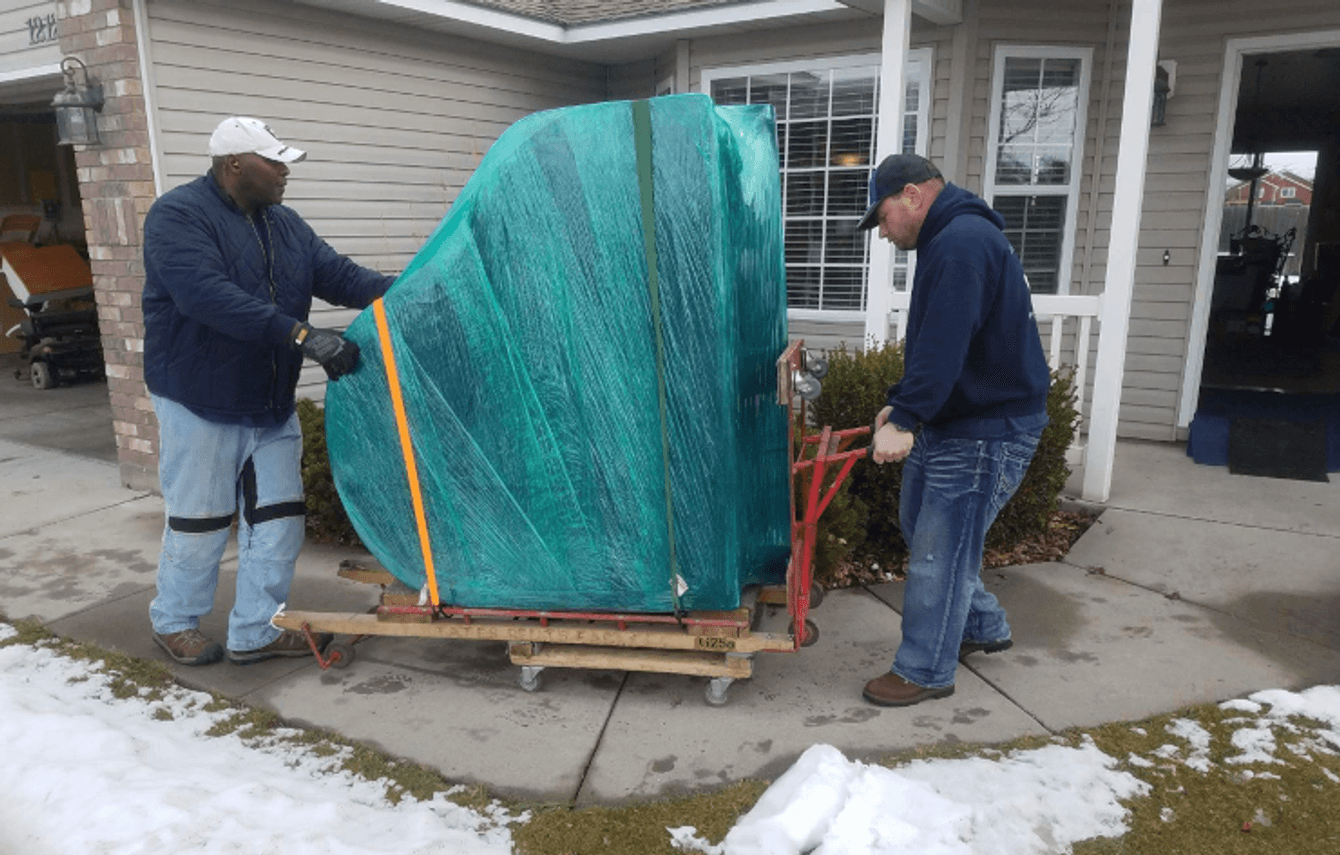
A piano is heavy, but the weight is not the difficult part. The weight sits high, it is concentrated in a small footprint, and it shifts. A grand comes apart and travels on its side on a padded board. An upright stays upright, wrapped and strapped to the same board. Neither one rolls anywhere on its own castors.
That is the whole of it, and most of what goes wrong with a piano goes wrong because one of those three things was skipped. Below is how we handle piano moves around Boise and the Treasure Valley, including the one job we are not taking right now.
The castors are not wheels
Look under a piano and you will find castors, and they will roll if you push. That is the trap. Those castors were fitted to let a piano be nudged a few inches on a level floor so a rug could go under it. They were not made to carry a piano across a room, down a driveway apron, or over a threshold strip.
What happens when they are used that way is not dramatic. A castor catches a seam in the concrete, the leg takes the load sideways instead of straight down, and the leg is what fails. On a grand it is a leg that costs more to repair than the move cost. On an upright it is a castor that snaps off and drops the corner onto whatever is under it.
Everything we move goes onto a four-wheel dolly and a padded piano board. The piano’s own hardware carries the piano only when the piano is standing still.
A grand does not travel the way it sits
A grand piano in a living room is a piece of furniture on three legs. A grand piano on a truck is a case lying on its long straight side, on a board, under blankets and shrink wrap, strapped down so it cannot move an inch.
Getting from the first state to the second is the work. The lid is secured, the legs come off, the pedal lyre comes off, and the case is lowered onto the padded board by hand — not tipped, lowered. It stays strapped to that board until it is standing in the new room, and then the legs and lyre go back on in the reverse order.
The reason for all of it is that a grand’s frame is designed to carry its own string tension in one plane. Lying on its side on a flat board, fully supported along that side, it is in a position it tolerates well. Carried upright by four people holding whatever they can reach, it is not.
An upright is not the easy one
People assume the upright is the simple job because it already stands the way it travels. It is the one where more goes wrong.
An upright is top-heavy and narrow front to back. Nothing about standing next to it tells you how quickly it wants to go over once it is tipped past its balance point. It gets wrapped, strapped to the board, and kept under two sets of hands the entire time it is moving — not because it is fragile, but because the moment it starts to fall there is no version of catching it that ends well.
Nothing gets loaded before it is wrapped. Blankets, straps and shrink wrap are included with the move, so there is no cost to us doing it properly and no reason to skip it. Boxes and packing paper are the only materials billed separately.
Stairs: the answer right now is no
We are booking piano jobs where both ends are on the level. No flights of stairs, either direction. That is a current limit and we would rather say it here, and again on the phone, than find it out with your piano halfway up a stairwell.
This comes up most in the foothills homes we move around Eagle, where a piano on a second floor or in a walk-out basement is common. If that is your situation, ask anyway — but ask early, because the answer will be no from us and you will want the time to call someone who does it.
Send a photo of both ends when you call and we will tell you straight away whether it is a job we can take.
What we need before we can quote it
Four things, and they are all things you can see from where you are standing:
- Upright or grand, and if it is a grand, roughly how long the case is from the keyboard to the tail.
- What is between the piano and the truck at both ends. Doorways, thresholds, a turn in a hallway, a gate, a lawn it has to cross.
- Whether either end has stairs. Say it first, not last.
- The building, if it is an apartment or a condo. Management often wants a certificate of insurance naming the building before a crew comes in, and we provide that when they ask for it. With a week it is a phone call. On the morning of the move it is a cancelled move.
We do not store anything, including pianos. We will load or unload one into a storage unit that is already yours, and that is the whole of what we do with storage.
Do not book the tuner for the same week
The piano will need tuning after the move. Almost all of them do. But a piano that has just been moved is still equalising to the humidity and the temperature of a room it has never been in, and the soundboard moves with that.
Give it two to four weeks in the new room, then call the tuner. Tuning it the day it arrives usually means paying for it twice.
What it costs, and when to call
Piano work is billed like the rest of our local moving: $100–$150 per hour for a crew of two, scaling with the crew. If we can drive out, do the job and get back the same day, it is billed by the hour. When the truck has to stay out overnight, it becomes a flat quoted price.
We answer the phone Monday to Saturday, 7am to 9pm, and we are closed Sundays. Tell us upright or grand, both addresses, and whether there are stairs. Ask for a quote and you will get a straight answer, including the times the straight answer is that this one is not ours to take.